Why go electric
The case for switching.
If you run a petrol fleet, switching to electric is a business decision — not an environmental gesture.
The shift is happening
Electric delivery fleets aren't an experiment anymore.
Battery-swap fleets are running at scale on three continents. The model is proven — what's new is that it's now available in South Africa.
What this means for you: the technology risk has been carried by others. Switching now means adopting a proven model early in your market — not betting on an unproven one.
Lower operating costs
Electric wins on cost — every month, every scooter.
The savings aren't marginal. They come from three directions at once, and they compound across every vehicle in your fleet.
⚡ Energy costs a fraction of fuel
Charging batteries costs roughly a third of the equivalent petrol per kilometre — before petrol's next price increase.
🔧 The service bill almost disappears
No oil changes, spark plugs, air filters, clutches, or timing adjustments. A shaft-driven electric motor's service list is tyres and brake pads.
📉 Fewer breakdowns, less downtime
An electric drivetrain has a fraction of the moving parts of a petrol engine. Fewer parts means fewer failures — and fewer days off the road.
per km on electric — versus
Typical energy/fuel cost per kilometre for a delivery scooter. Full comparison on our homepage; exact numbers for your fleet via the savings calculator.
Zero charging downtime
The problem with EVs was never electric. It was waiting.
Plug-in charging is what kept delivery fleets on petrol — no operator can park revenue for hours. Battery swap removes the waiting entirely.
Plug-in EV
4–8 hrs
Conventional charging takes the scooter — and the rider — off the road for hours at a time.
Petrol
10–15 min
Quick, but adds up: detours to the garage, queues, and cash handling — several times a week per scooter.
Ecoworks swap
60 sec
Swap both packs at a station on the delivery route and go. Refuelling stops being a cost line at all.
A fully charged pair of batteries is always waiting at the station — your rider never plugs anything in. See exactly how a swap works →
Built for SA conditions
Designed around South African realities.
The honest objections to electric in South Africa — the grid, the range, the roads — are exactly what the Ecoworks system was built to answer.
⚡ Load-shedding resilient
Swap stations charge batteries whenever power is available and hold them fully charged on standby. During an outage, your riders keep swapping — while fuel pumps and plug-in chargers both go offline.
🗺️ Range answered by the network
Up to 90km per charge, with stations placed along delivery routes. Range anxiety is a plug-in problem — when a full battery is 60 seconds away, range stops being a limit.
🛣️ Made for local roads
Long-stroke suspension, hydraulic disc brakes, and all-weather tyres — specified for real delivery conditions, from smooth suburbs to potholed shortcuts and steep inclines.
The cost gap is only widening
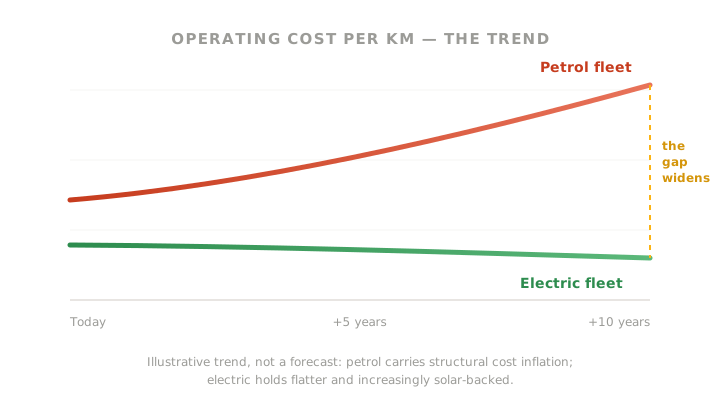
Petrol has inflation built in. Electric doesn't.
Every rand-per-litre at the pump carries the oil price, the rand-dollar exchange rate, and fuel levies that rise almost every year. None of those forces work in your favour — and none of them are within your control.
Electricity per kilometre is structurally cheaper today, and the trajectory favours it further: as swap stations pair with solar and storage, the cost of charging decouples from both the grid and the pump entirely.
Switching isn't just saving this year's money. It's choosing the flatter cost curve for the next decade — while your petrol-bound competitors absorb every increase.
And one more thing: your spend stays home.
Most of every rand spent on petrol leaves the country to pay for imported fuel. Every rand spent on electricity circulates in the South African economy. An electric fleet doesn't just cost you less — it redirects your operating spend from imports into the local economy. A better fleet decision that happens to be a better national one, too.
Run the numbers on your fleet.
The argument is only as good as your own figures. Tell us your fleet size and monthly fuel spend, and we'll show you exactly what switching saves.